
Singalila National Park on the Singalila Ridge in Darjeeling district is a high altitude temperate forest, famous for red pandas, rhododendrons and Sandakphu views.
Singalila National Park sits on the Singalila Ridge in Darjeeling district in West Bengal, along the border with Nepal and Sikkim, in the Eastern Himalayas. It was declared a wildlife sanctuary in 1986 and upgraded to a national park in 1992, covering about 78.6 sq. km, making it one of India’s smallest national parks by area, but one of its most important by biodiversity. The park takes its name from the Singalila spur, which runs from Manebhanjan in the south to Phalut and Sandakphu in the north.
The landscape is high altitude temperate forest, with broad leaved forest, mixed forest, rhododendron and magnolia groves, and alpine vegetation at higher levels, between about 2,400 and 3,600 m. Rivers Rammam and Sirikhola drain the park, and the ridge itself gives views that are famous across the Himalayas. Sandakphu, at 3,636 m, is the highest peak in West Bengal, and Phalut, at 3,600 m, is the second highest point on the ridge, both inside or on the edge of the park area.
Singalila is one of India’s most critical habitats for the endangered red panda, with a relocation programme in 2004 helping to build a thriving population, and with habitat protection, anti poaching work and community engagement central to its conservation. The park also holds Himalayan black bear, clouded leopard, leopard cat, barking deer, wild boar, yellow throated marten, pangolin and more than 200 bird species, including satyr tragopan and other Himalayan pheasants, making it one of India’s best birding areas.
The trekking story is central to Singalila. The Sandakphu to Phalut trail, starting at Manebhanjan and passing through Tonglu, Tumling, Kalapokhri, Sandakphu and Phalut, is one of India’s most famous treks, offering at sunrise a panoramic view of four of the world’s five highest peaks, Everest, Kanchenjunga, Lhotse and Makalu, all over 8,000 m. Rhododendron blooms in March to May turn the forest into colour, and the ridge road, used by 4×4 vehicles, allows travellers to combine trekking on foot with vehicle support between birding stops.
For a visitor, Singalila suits trekkers, birders and red panda watchers, rather than jeep safari travellers. It is best planned as a 3 to 5 day Manebhanjan to Sandakphu and Phalut journey, with stays in trekker huts and homestays along the ridge, and with a local guide and spotter for red pandas. It pairs with Darjeeling town, Mirik and Sikkim, and it rewards slow, early morning birding and ridge walking over a single day visit.
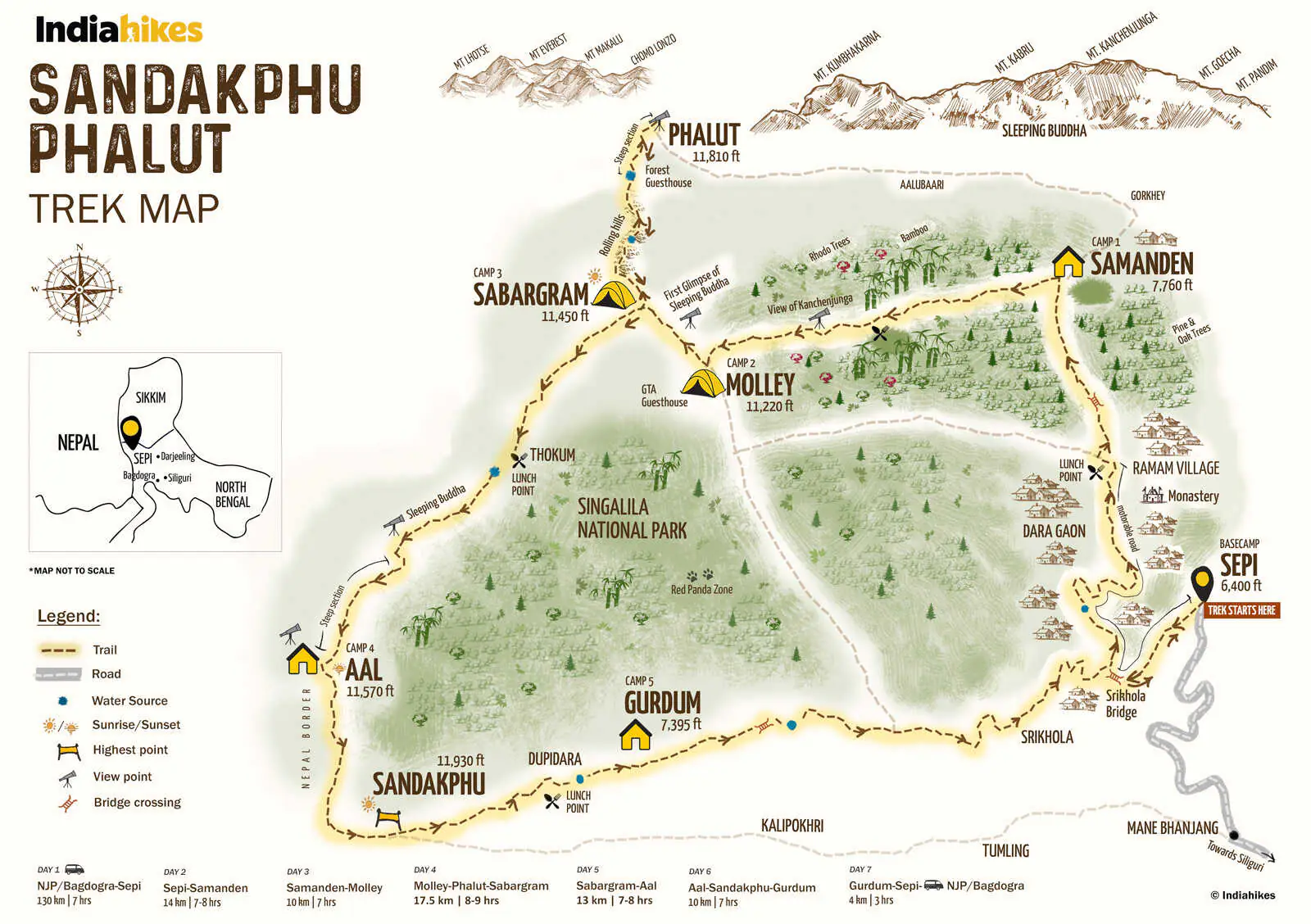
Singalila has no jeep safari timings. Trekking is by day, with early morning starts for birds and red pandas, and stays in trekker huts and homestays along the ridge. A Manebhanjan to Sandakphu trek takes at least 5 to 6 days for the full route, with shorter 3 to 5 day options to Sandakphu alone. Entry permits are required at Gairibans and other entry points, and every visitor needs photo ID matching the permit details. Best seasons are March to May and October to November, with red panda sightings best in March to May. Share your dates and fitness level early and we will match route and stays to your plan.
Singalila has no jeep safari zones. The ridge is divided into sections from south to north. Manebhanjan to Tonglu and Tumling, Tumling to Kalapokhri, Kalapokhri to Sandakphu, Sandakphu to Phalut, and Phalut to Gorkhey. Each section has its own altitude, forest type and birding pattern, with rhododendron forest strongest in spring and alpine views strongest at Sandakphu and Phalut. Access is on foot or by 4×4 on the ridge road, depending on section and weather.
March to May and October to November.
Bagdogra, with Darjeeling as the nearest town.
About 5 to 15°C in season, colder at night at altitude.
About 3,500 mm annually, monsoon June to September.
By train: New Jalpaiguri station is the nearest major railhead, with Darjeeling town as the hill base. From New Jalpaiguri, drive to Darjeeling and then to Manebhanjan.
By road: Manebhanjan is about 25 km from Darjeeling town by road, and about 85 km from New Jalpaiguri. The trek starts at Manebhanjan, with 4×4 support on the ridge road.
By air: Bagdogra airport is the nearest airport, with onward drive to Darjeeling and Manebhanjan.
Stays for Singalila are in Darjeeling town before and after treks, and in trekker huts, homestays and lodges along the ridge at Tonglu, Tumling, Kalapokhri, Sandakphu and Phalut. There is no lodge inside the park in the usual safari sense. Homestays along the ridge are simple and warm, and they are central to red panda conservation income. Tell us your route first so hut and homestay bookings match your nights.
Red panda, Himalayan black bear, clouded leopard, leopard cat, barking deer, wild boar, yellow throated marten, pangolin, and more than 200 bird species including satyr tragopan, Himalayan pheasants and other high altitude birds. A red panda sighting is never guaranteed on a single day, even in peak season. Several days on the ridge with a local spotter give a far better chance than a single day drive.


Stays during treks are in trekker huts and homestays along the ridge inside and on the edge of the park area, arranged with local guides. Darjeeling town stays are used before and after treks.
Manebhanjan is about 25 km from Darjeeling town by road, and the trek starts at Manebhanjan for Sandakphu and Phalut.
Singalila National Park is situated in Darjeeling district of West Bengal, on the Singalila Ridge along the Nepal border, with Sandakphu as the highest peak in West Bengal. Manebhanjan is the main gateway.
Manebhanjan is a road drive from Bagdogra airport through Darjeeling town, with Bagdogra as the nearest airport, followed by road to Darjeeling and Manebhanjan.
Discover the wilderness at your own pace with a journey designed around you. Share your travel plans with us, and let us curate a personalised safari experience filled with wildlife, exploration and unforgettable moments.

A journey through Bengal where festival traditions, wetlands and wildlife come together.
A journey through Bengal where festival traditions, wetlands and wildlife come together.
A journey through Bengal where festival traditions, wetlands and wildlife come together.
