
Similipal National Park in Mayurbhanj district of Odisha is a vast sal forest and biosphere reserve, known for tigers, elephants, waterfalls and tribal culture.
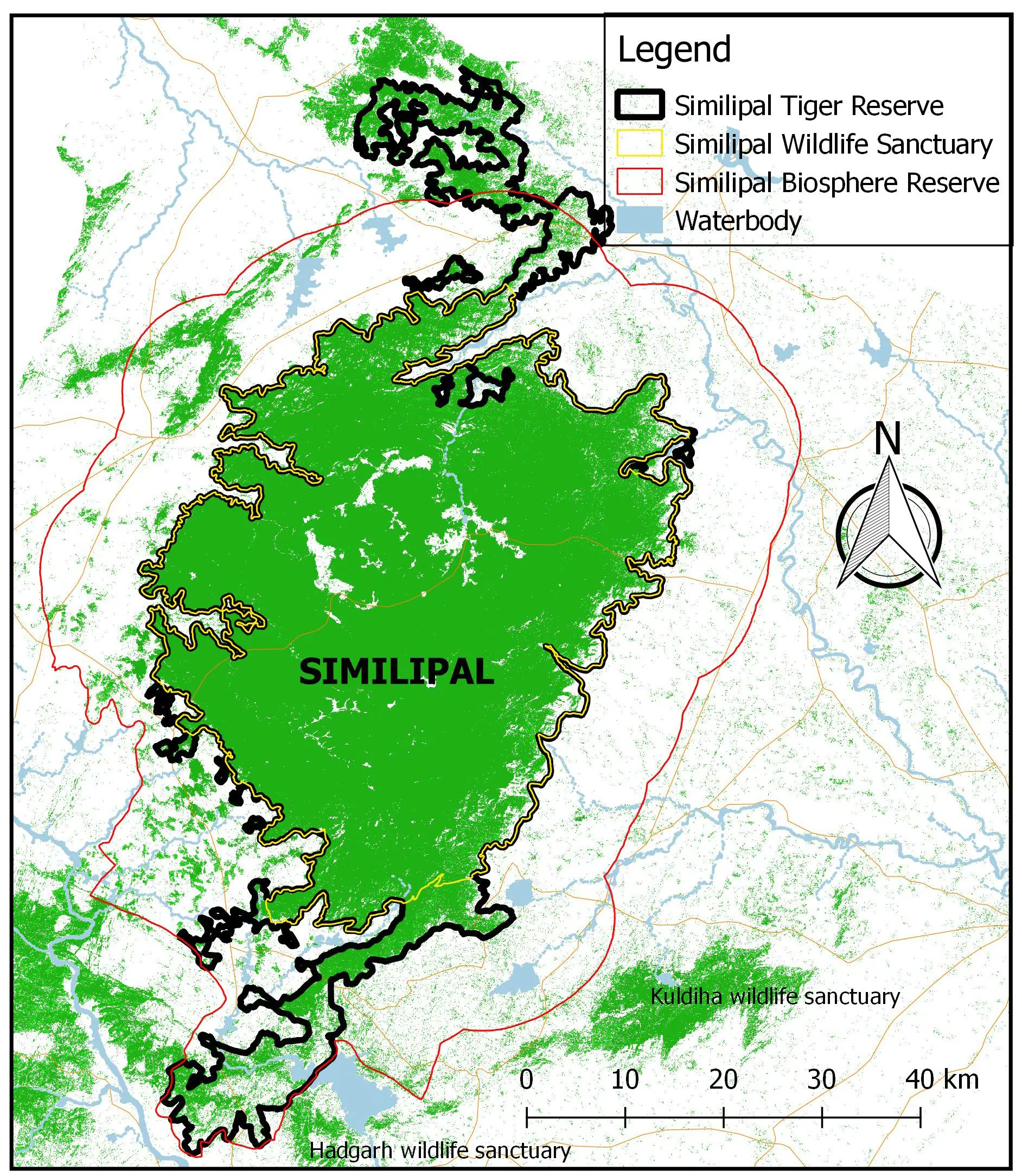
Similipal National Park sits in Mayurbhanj district in Odisha, in the northeast corner of the Deccan Plateau, with its own climate impact from the Similipal hills. It was once a hunting ground for royalty, was formally designated a tiger reserve in 1973 under Project Tiger, declared a wildlife sanctuary in 1979, proposed as a national park in 1980 and expanded to 845.70 sq. km in 1986, and declared a biosphere reserve in 1994, with UNESCO World Network of Biosphere Reserves status in 2009.
The landscape is moist deciduous sal forest, dry sal savanna, semi evergreen valleys, hills, rivers and waterfalls, with the park named from semul, red silk cotton trees, that bloom abundantly here. Khariburu and Meghasani hills form the highlands of the southern core, while the northern zone has sloping mountains and destinations like Joranda, Barehipani, Lulung and Sitakund. Joranda and Barehipani waterfalls are among India’s highest, and they give Similipal a scenic, hilly feel that is different from a flat forest park.
Similipal is known for Royal Bengal tigers, whose numbers rose from 17 in 1973 to 99 by 2002 in historical counts, Asian elephants, leopards, gaur, sambar, chital, mugger crocodiles and a rich birdlife, with the park also part of the Mayurbhanj Elephant Reserve, which includes Hadgarh and Kuldiha wildlife sanctuaries. It is also known for melanistic tigers, the famous black tigers of Similipal, which are a rare colour variant found here, though sightings are extremely rare.
The conservation story includes the Mugger Crocodile Scheme started in 1979 at Ramatirtha near Jashipur, elephant protection through the Mayurbhanj Elephant Reserve, and biosphere management that includes tribal villages in the buffer zone. That buffer life matters for a visitor, because Similipal’s buffer includes villages, valleys and rivers where people live alongside forest, and tourism is managed through nature camps and eco development committees rather than only through jeep routes.
For a visitor, Similipal suits a longer Odisha journey, with nature camp stays inside the reserve at Kumari, Gudgudia, Chahala, Barehipani and Jamuani, and with day visits through Pithabata and Jashipur gates. It suits travellers who want waterfalls, hills, forest and tribal culture as much as tigers, and who are happy to plan around vehicle limits, ground clearance rules and fixed entry and exit times, rather than a flexible single day drive.
Similipal is open for visitors from 1 November to 15 June in the 2026-27 season, after monsoon closure, with day visits entering through Pithabata and Jashipur gates. In 2026-27, entry through Jashipur gate is 5:00 to 9:00 and through Pithabata gate 8:00 to 9:00, with a maximum of 60 vehicles per day, 35 through Jamuani route and 25 through Pithabata route, and all visitors must leave Joranda and Barehipani waterfalls by 16:00 and exit the park by 18:00. A guide is mandatory, and vehicles need at least 180 mm ground clearance. Permits are limited and every visitor needs photo ID matching the permit details. Share your dates early and we will match gate and camp to your plan.
Similipal has two distinctive zones, Southern and Northern, plus core and buffer areas. Southern Zone exhibits highlands like Khariburu and Meghasani and is the core region. Northern Zone is mostly for tourists, with sloping mountains and destinations like Joranda, Barehipani, Lulung and Sitakund. Main visitor areas include Chahala Zone for wildlife spotting, Kumari, Gudgudia, Barehipani and Jamuani nature camp areas, and Pithabata and Jamuani entry routes. Each route has its own landscape, waterfalls and wildlife pattern, and entry gate determines the route for the day.
November to March, season 1 November to 15 June.
Bhubaneswar, with Kolkata as a larger option.
Cool winters, warm summers, humid monsoon.
Monsoon, June to September, park closed.
By train: Baripada station is the nearest railhead for Pithabata Gate, with Balasore and Bhubaneswar as larger rail hubs. From Baripada, drive about 22 km to Pithabata Gate.
By road: Pithabata Gate is about 22 km from Baripada and about 98 km via Jashipur from the other side, with Baripada connected by road to Bhubaneswar and Kolkata. Jashipur Gate is near national highways.
By air: Bhubaneswar airport is the nearest major airport, with Kolkata airport as a larger option, followed by road to Baripada and Pithabata Gate.
Stays for Similipal are in nature camps inside the reserve at Kumari, Gudgudia, Chahala, Barehipani and Jamuani, booked in advance, and in lodges outside the park near Baripada and Jashipur for day visits. Nature camp stays are the best way to experience Similipal deeply, as day visits must exit by 18:00. Tell us your gate and camp first, as Pithabata and Jashipur routes lead to different camps.
Bengal tiger, including rare melanistic tigers, leopard, Asian elephant, gaur, sambar, chital, wild boar, langur, mugger crocodile, and rich birdlife. A tiger sighting is never guaranteed on a single day route. A nature camp stay plus a day route gives a far better chance and time for waterfalls, hills and forest.


Yes, nature camp stays inside the reserve are available at Kumari, Gudgudia, Chahala, Barehipani and Jamuani, booked in advance. Day visitors must exit by 18:00.
Pithabata Gate is about 22 km from Baripada by road, with Jashipur Gate about 98 km via Jashipur from the other side. Stay near Baripada for Pithabata day visits.
Similipal National Park is situated in Mayurbhanj district of Odisha, in the northeast Deccan Plateau, as part of Similipal Tiger Reserve and Biosphere Reserve. Pithabata and Jashipur are the main gateways.
Baripada is a road drive from Bhubaneswar airport, with Bhubaneswar as the nearest major airport and Kolkata as the larger option, followed by road to Baripada and Pithabata Gate.
Discover the wilderness at your own pace with a journey designed around you. Share your travel plans with us, and let us curate a personalised safari experience filled with wildlife, exploration and unforgettable moments.

A journey through Bengal where festival traditions, wetlands and wildlife come together.
A journey through Bengal where festival traditions, wetlands and wildlife come together.
A journey through Bengal where festival traditions, wetlands and wildlife come together.
