
Pilibhit Tiger Reserve in the Terai of Uttar Pradesh, near the Nepal border, is a dense sal forest and grassland reserve, famous for tigers and for Chuka Beach.
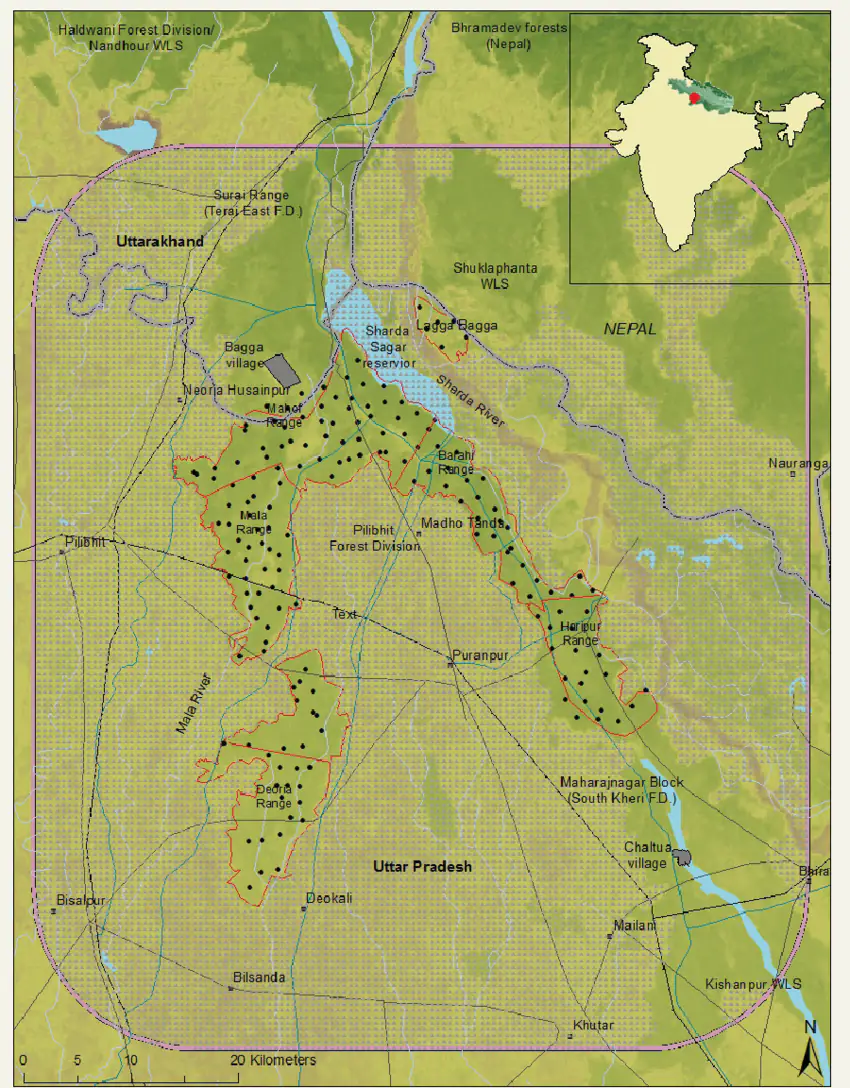
Pilibhit Tiger Reserve sits in Pilibhit district in Uttar Pradesh, in the Terai region near the Indo Nepal border, on the bank of the Sharda River. It was once a royal hunting ground, was notified as a tiger reserve in 2014 as India’s 45th tiger reserve, and it forms a crucial corridor for tigers between Kishanpur Wildlife Sanctuary, part of Dudhwa Tiger Reserve, and forest areas in Nepal and Uttar Pradesh. That corridor role is central to its conservation value.
The landscape is dense sal forest, covering about 90 percent of the reserve, with lush meadows, grasslands, canal networks, marshy wetlands and seasonal streams, and the Sharda Sagar Dam forming a large water body at Chuka. The forest feels dense and quiet, with thick sal canopy in Mahof and more open grassland in Barahi, giving Pilibhit a varied, Terai feel that is different from a dry forest park. Chuka Beach, on the Sharda Sagar Dam, is the only forest beach in Uttar Pradesh, and it gives the reserve a unique eco tourism identity beyond safaris alone.
Pilibhit is known for a high tiger density, with calm forest and relatively low tourist footfall compared with more popular reserves, which makes it a favourite among serious wildlife lovers. It also holds leopards, elephants, swamp deer, hog deer, wild boar, and more than 200 bird species, with the reserve winning a global tiger award for increased tiger numbers in recent years. The combination of high density and low crowds is why Pilibhit is often described as a hidden gem in the Terai.
The conservation story is about a corridor reserve that works because it connects larger forests. Tigers move between Pilibhit, Dudhwa, Katarniaghat and Kishanpur, and protecting Pilibhit protects that movement. That corridor function also means Pilibhit’s forests, grasslands and wetlands must be managed together, with buffer villages, canals and dams as part of the same landscape, not as separate from the forest.
For a visitor, Pilibhit suits a quiet Terai trip with Dudhwa, and it suits travellers who want tigers without crowds, plus a unique stay at Chuka Beach huts. It is best planned with two drives, one in Zone 1 Mahof and Chuka area and one in Zone 2 Barahi and Mustafabad area, plus time at Chuka Beach for sunrise and sunset, rather than a single drive in one zone.
Safaris run twice a day, morning and afternoon. Winter timings are reported as about 6:30 to 10:00 in the morning and 2:30 to sunset in the afternoon, summer timings from 1 April to 15 June about 6:00 to 9:30 and 3:30 to sunset. Final times are given at booking and shift with season. A jeep seats up to six or seven visitors depending on vehicle, plus driver and guide. Permits are zone specific and limited, and every visitor needs photo ID matching the permit details. Tourism season is now 1 November to 30 June, extended from the earlier 15 November to 15 June, with monsoon closure July to October. Share your dates early and we will match zone to plan.
Pilibhit is divided into two official safari zones for jeep safaris. Zone 1 is Mahof Zone, accessed primarily through Mahof Gate, known for thick sal canopy, quieter trails and excellent tiger and leopard chances, with Chuka Eco Tourism area and Chuka Beach within this zone. Zone 2 covers Barahi and Mustafabad area, accessed through Barahi Gate and Mustafabad Gate, known for open grasslands, wider vistas, greater tiger mobility and birdwatching. Mustafabad Gate, also called Chuka Eco Tourism Area gate, serves as the main tourism hub and connects to both Zone 1 and Zone 2 depending on permit availability. The reserve has five core forest ranges, Mahof, Barahi, Mala, Haripur and Deoria, plus Khutar range in Shahjahanpur as buffer.
November to June, season 1 November to 30 June.
Bareilly, with Lucknow as a larger option.
Cool winters, warm summers, humid monsoon.
Monsoon, July to October, park closed.
By train: Pilibhit station is the nearest railhead, with Bareilly as the main rail hub. From Pilibhit city, drive to Mahof, Mustafabad or Barahi gates.
By road: Mustafabad Gate is about 50 km from Pilibhit city by road, with Mahof and Barahi gates reached by road from Pilibhit city and Mustafabad. Chuka Beach is reached through Mahof or Mustafabad gates.
By air: Bareilly airport is the nearest airport, with Lucknow airport as a larger option, followed by road to Pilibhit city and gates.
Stays for Pilibhit are in Chuka Beach huts inside the forest area, including bamboo huts, tree huts and Tharu huts, and in lodges outside the park near Pilibhit city and Mustafabad. Chuka stays are the most distinctive option, with dam views and forest surroundings. Tell us your zone first, as Chuka stays suit Zone 1 and Mustafabad stays suit both zones.
Bengal tiger, leopard, Asian elephant, swamp deer, hog deer, sambar, chital, wild boar, langur, and more than 200 bird species. A tiger sighting is never guaranteed on a single drive. Two drives, one in Zone 1 and one in Zone 2, plus a Chuka stay, give a far better chance.


Yes, Chuka Beach huts inside the forest area, including bamboo huts, tree huts and Tharu huts, are available with forest department permission. Most other stays are outside the park near Pilibhit city and Mustafabad.
Mustafabad Gate is about 50 km from Pilibhit city by road, with Chuka Beach reached through Mahof or Mustafabad gates. Stay at Chuka for Zone 1 access.
Pilibhit Tiger Reserve is situated in Pilibhit district of Uttar Pradesh, in the Terai near the Indo Nepal border, on the bank of the Sharda River. Mahof, Mustafabad and Barahi are the main gateways.
Pilibhit city is a road drive from Bareilly airport, with Bareilly as the nearest airport and Lucknow as the larger option, followed by road to Pilibhit city and gates.
Discover the wilderness at your own pace with a journey designed around you. Share your travel plans with us, and let us curate a personalised safari experience filled with wildlife, exploration and unforgettable moments.

A journey through Bengal where festival traditions, wetlands and wildlife come together.
A journey through Bengal where festival traditions, wetlands and wildlife come together.
A journey through Bengal where festival traditions, wetlands and wildlife come together.
