
Parambikulam Tiger Reserve in Palakkad district of Kerala is a Western Ghats valley of teak, bamboo and reservoirs, between Anaimalai and Nelliampathy hills.
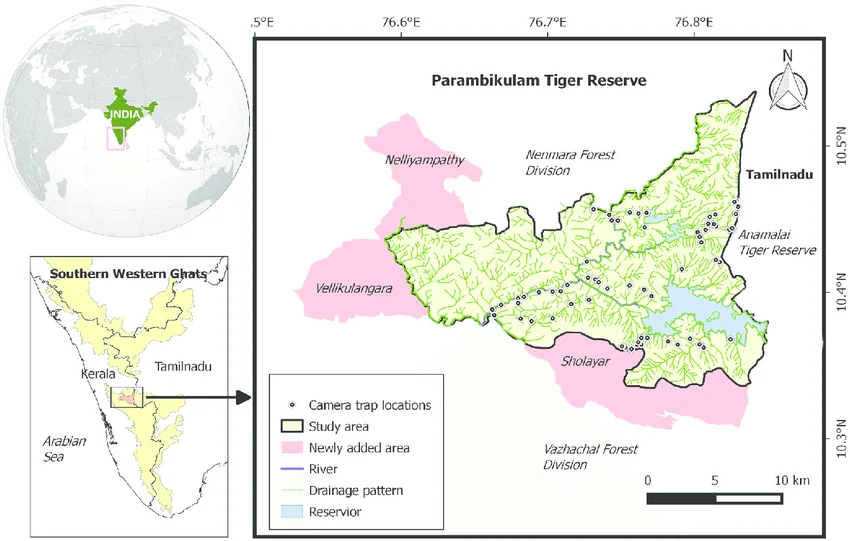
Parambikulam Tiger Reserve sits in Palakkad and Thrissur districts in Kerala, in the Sungam range of hills between the Anaimalai Hills and Nelliampathy Hills, in the southern Western Ghats. The wildlife sanctuary, covering 285 sq. km, was established in part in 1973 and 1984, and it was declared as part of Parambikulam Tiger Reserve on 19 February 2010, with a total area of 643.66 sq. km including buffer. The Western Ghats, Anamalai Sub Cluster, including all of Parambikulam Wildlife Sanctuary, has been declared a UNESCO World Heritage Site.
The landscape is hilly and rocky, drained by the Parambikulam, Sholayar and Thekkedy rivers, with seven major valleys and three man made reservoirs, Parambikulam, Thunacadavu and Peruvaripallam, with a combined area of 20.66 sq. km. Altitude ranges from 300 m to 1,438 m at Karimala Gopuram on the southern boundary, with Pandaravarai at 1,290 m in the north and other peaks along the boundaries. Thick forest of bamboo, sandalwood, rosewood and teak covers the hills, with marshy land and scattered grassland patches in valleys.
Parambikulam is known for tigers, leopards, Asian elephants, gaur, sambar, sloth bears, Nilgiri langurs, lion tailed macaques and a rich birdlife, with the reserve forming a missing link in a chain of seven conservation areas stretching 4,000 sq. km across southern India. That link role matters, because Parambikulam connects Anaimalai in Tamil Nadu with Nelliampathy, Vazhachal and Chalakudy forests in Kerala, allowing elephants and tigers to move across the Western Ghats.
The conservation story includes the Cochin State Forest Tramway, remnants of which remain in the reserve, once used to ship wood from Parambikulam forests to Kochi harbour, a reminder of a timber past now replaced by protection. Today the reserve limits vehicles to about 30 per day for tourists, with movement restricted to prescribed routes and all vehicles required to leave before sunset, giving Parambikulam a quieter, more controlled tourism model than many larger reserves.
For a visitor, Parambikulam suits a Kerala and Tamil Nadu Western Ghats journey, with Pollachi as the main town gateway, and it suits travellers who want reservoirs, boat cruises, tree houses and forest rest houses as well as safaris. It is best planned as a 2 day stay at Thunacadavu, Thellikkal or Elathode forest rest houses, with a guided bus safari and a boat cruise, rather than a single day drive from Pollachi.
Parambikulam is open throughout the year in many services, but best avoided during monsoon, with the main visitor season October to May in other services. Entry is restricted to about 30 vehicles per day for tourists, with all vehicles required to leave before sunset. Wildlife watching by bus is on a prescribed route, with timings set by the forest department. Permits are limited and advance booking is strongly recommended, especially October to February peak season. Every visitor needs photo ID matching the permit details. Share your dates early and we will match stay and safari to your plan.
Parambikulam is divided into Core Zone, Buffer Zone and Tourism Zone. Core Zone is preserved as the most undisturbed habitat, Buffer Zone is managed for habitat improvement and protection, and Tourism Zone is the only area open to tourists, on prescribed routes. Main visitor areas include Anappadi watchtower, 8 km from Thunakadavu, Zungam watchtower, 5 km from Thunakadavu, Thunacadavu reservoir area, and Parambikulam reservoir area. Each area has its own landscape, with reservoirs, valleys and forest giving different wildlife patterns.
October to March, season October to May.
Coimbatore, with Kochi as a larger option.
About 15 to 32°C, cooler in mornings with mist.
About 1,600 mm, monsoon June to August and October to November in eastern parts.
By train: Pollachi station is the nearest railhead, with Palakkad and Coimbatore as larger rail hubs. From Pollachi, drive about 58.7 km to Parambikulam.
By road: Parambikulam is about 110 km from Palakkad town and about 58.7 km from Pollachi by road, with two daily bus services to the reserve from Pollachi as the easiest public transport option.
By air: Coimbatore airport is the nearest airport, with Kochi airport as a larger option, followed by road to Pollachi and Parambikulam.
Stays for Parambikulam are in forest department rest houses at Thunacadavu, Thellikkal and Elathode, plus a tree house in the reserved forest area at Thunacadavu booked in advance, and in lodges near Pollachi for day visits. Forest rest house stays are the best way to experience Parambikulam deeply, as vehicles must leave before sunset for day visitors. Tell us your stay first, as Thunacadavu rest house bookings fill quickly in peak season.
Bengal tiger, leopard, Asian elephant, gaur, sambar, sloth bear, Nilgiri langur, lion tailed macaque, wild boar, and rich birdlife. A tiger sighting is never guaranteed on a single bus safari. A forest rest house stay plus a bus safari and a boat cruise give a far better chance and time for elephants at reservoirs.


Yes, forest department rest houses at Thunacadavu, Thellikkal and Elathode, plus a tree house at Thunacadavu booked in advance, are available inside the reserve area. Day visitors must leave before sunset.
Parambikulam is about 58.7 km from Pollachi by road, with Pollachi as the main gateway town. Stay at Thunacadavu for reservoir safaris.
Parambikulam Tiger Reserve is situated in Palakkad and Thrissur districts of Kerala, in the Sungam hills between Anaimalai and Nelliampathy ranges. Pollachi is the main gateway.
Pollachi is a road drive from Coimbatore airport, with Coimbatore as the nearest airport and Kochi as the larger option, followed by road to Pollachi and Parambikulam.
Discover the wilderness at your own pace with a journey designed around you. Share your travel plans with us, and let us curate a personalised safari experience filled with wildlife, exploration and unforgettable moments.

A journey through Bengal where festival traditions, wetlands and wildlife come together.
A journey through Bengal where festival traditions, wetlands and wildlife come together.
A journey through Bengal where festival traditions, wetlands and wildlife come together.
